Case study · Shopify & Ecommerce
Fairfax & Favor
More than a decade supporting one of British fashion's standout growth stories.
We've worked with Fairfax & Favor since 2013.
The business we first started working with and the Fairfax & Favor of today are very different in scale, but the relationship has remained remarkably consistent: an ambitious internal team, continually investing in its brand and customer experience, with TRS working alongside them on ecommerce.
That longevity gives us something valuable that can't be recreated at the beginning of a new agency relationship.
We know the brand, its customers and much of the thinking that has brought the ecommerce experience to where it is today.
Working together since
2013
Platform
Shopify Plus
Relationship
Monthly ongoing development & support
Work
UX · Development · Custom apps · Integrations

Platform evolution
Continually evolving Shopify
Shopify itself has changed enormously during the time we've worked with Fairfax & Favor.
Functionality that once required APIs or private applications has gradually become native to the platform through developments such as metafields, metaobjects, Shopify Functions and checkout extensions.
We've continually adopted those capabilities as they've become available, sometimes replacing things we previously had to build ourselves, and sometimes using them as the foundation for something more bespoke.
Not simply adding more code, but knowing when the platform has developed enough to let us simplify it again.
Retail experience
Connecting online and physical retail
As Fairfax & Favor's retail presence has expanded, ecommerce increasingly needs to work alongside its physical stores.
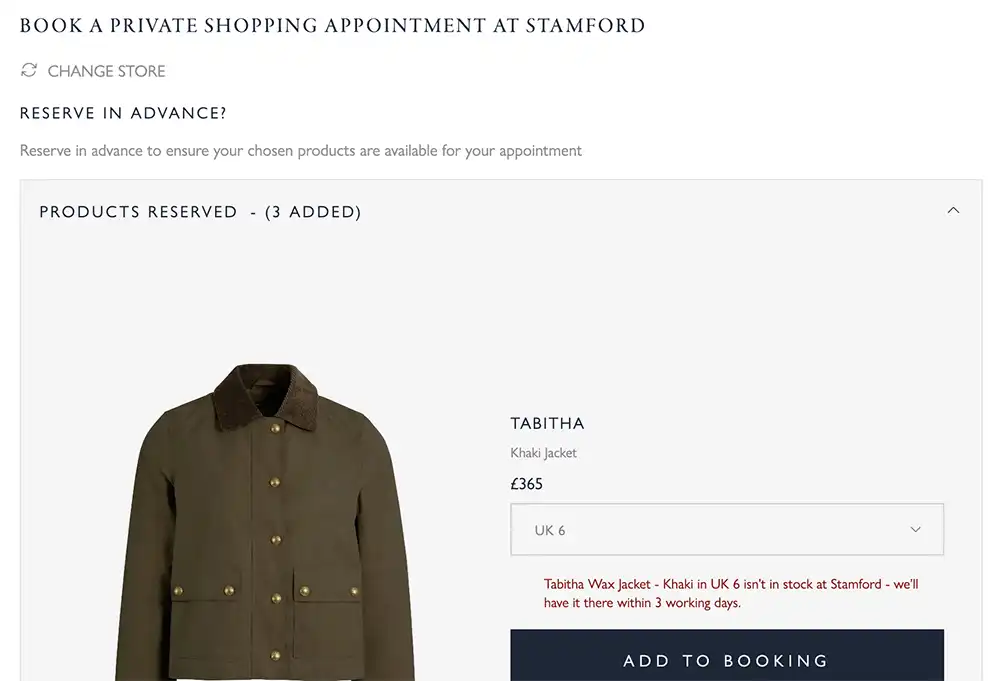
We developed a bespoke private appointments system allowing customers to arrange a one-to-one store visit and specify the products they'd particularly like to try.
The booking journey takes store location and availability into account, while giving the retail team advance knowledge of what the customer is interested in so appropriate stock can be prepared for their visit.
It's a good example of digital functionality making the physical experience better.
Ecommerce detail
Small details that make ecommerce better
A lot of ecommerce improvement happens in places that would never justify a project launch of their own.
We've developed functionality around gifting, including a checkout extension that lets customers add gift wrapping without leaving the checkout journey.
Behind the scenes, bespoke tools help the team manage personalised gift messages and control the allocation of e-gift cards securely, including permissions that prevent individual warehouse users from creating or allocating arbitrary values.
We've also developed Fairfax & Favor's wishlist functionality, allowing customers to save products, merge selections when they sign into their account and create a shareable wishlist with its own URL.
These aren't headline-grabbing technologies.
They're useful details that remove friction for customers and make the operation behind the website work better.
Seasonal trading
Supporting campaigns and seasonal trading
Fashion ecommerce has moments when large numbers of customers want access at exactly the same time.
For sales and launches, we've developed a flexible locking system that allows sections of the storefront to be password protected and opened to selected customers.
What began as a more specific requirement has developed into configurable functionality using Shopify metaobjects, allowing multiple locks and campaigns to be managed simultaneously.
It's another example of something initially developed to solve one requirement becoming a reusable tool for the team.
Access logic
Multiple campaigns and locks, configured through Shopify metaobjects
- 01 Campaign or lock created
- 02 Shopify metaobjects
- 03 Storefront access rules
- 04 Selected customers
Shopify ecosystem
Search, integrations and everything around Shopify
Across more than a decade we've worked with different technologies around the core store as Fairfax & Favor's requirements have changed.
That has included search platforms such as Algolia and Tagalys before later moves towards Shopify's own search capabilities, integrations with systems including Brightpearl, and custom applications and API work where Shopify alone hasn't provided what was needed.
Some of those technologies are still relevant. Others have been replaced.
The important part isn't the list of platforms.
It's having enough context to know how the different pieces fit together and when something should change.
From our side
We've worked with Fairfax & Favor since 2013, so we've seen the business change enormously. What hasn't changed is their willingness to invest, try things and keep improving.
It's easy for an agency to point at a successful client and claim some of the credit. The reality is that we're one part of a very good team, and after more than a decade we're genuinely invested in what happens next.